If you were to strip away the drywall of any modern home, office, or industrial facility, you would find an interesting network of electrical conduits. At the critical intersections of this hidden nervous system sits a small, yet immensely important device: the electrical Round junction box.
Historically forged from heavy cast iron or galvanized steel, the industry has undergone a massive shift toward advanced polymers. Whether you are searching for the best PVC Junction Box 4 Way for a complex smart-home setup, comparing a metal vs. PVC junction box, or simply trying to understand code compliance to keep your property safe, this comprehensive guide has you covered.

We will break down the material science, technical specifications, dimensional parameters, installation guidelines, and answer the internet’s most pressing FAQs regarding electrical enclosures.
- 1. What is a Junction Box Used For and Why is it Required?
- 2. Material Science: Metal vs. PVC Junction Boxes
- 3. Technical Specifications and Dimensions
- 4. Architectural Configurations: The 1-Way to 4-Way Dynamics
- 5. Avoiding "The Volume Trap": Standard vs. Deep Junction Boxes
- 6. Proper Installation: Hardware, Welding & Waterproofing
- 7. Answering Top Electrical Rules and FAQs
- 8. Market Dynamics: Junction Box Prices and Top Brands
- 9. Conclusion: Securing Your Infrastructure
1. What is a Junction Box Used For and Why is it Required?
At its core, a junction box is a secure, engineered housing unit designed to isolate electrical wire connections (splices) from environmental threats, moisture & mechanical impact.
Is a junction box required? Yes. Electrical codes worldwide suggests that every single wire splice must be contained within an approved, accessible enclosure. This serves three vital purposes:
- Fire Containment: If a loose connection causes electrical hazard (sparks), the box contains the localized heat, preventing the ignition of surrounding wood or drywall.
- Shock Prevention: It shields building occupants and pets from accidental contact with live, high-voltage conductors.
- Mechanical Relief: It acts as a structural anchor, removing physical pulling tension from delicate copper wire joints.
Can a Fire Start in a Junction Box?
Yes, a fire can start inside one - usually due to a poorly executed splice that increases localized electrical resistance, generating intense heat. However, a high-quality junction box is designed to safely contain that failure. Modern boxes feature Fire Retardant Low Smoke (FRLS) properties. Tested under strict standards (like the UL 94 V-0 rating), premium boxes possess self-extinguishing characteristics, meaning combustion/fire completely ceases within 10 seconds.
Read more: Is Your Home Fire-Safe? The Critical Electrical Checklist Most People Skip.
2. Material Science: Metal vs. PVC Junction Boxes
The debate between metal and plastic is common, but understanding the chemical and structural differences will dictate exactly what you need for your project.
The Rise of Unplasticized PVC (uPVC K-67)
When you buy a standard PVC Junction Box, you aren't just buying cheap plastic. High-grade electrical boxes are manufactured using virgin suspension grade K-67 unplasticized PVC (uPVC).
- The "Unplasticized" Advantage: Standard PVC contains plasticizers to make it bendable (like garden hoses). By omitting these, manufacturers create a rigid, highly durable matrix capable of surviving severe mechanical impact.
- No Grounding Required: Because uPVC is 100% non-conductive, you do not need to attach a system-level ground wire to the box itself, vastly simplifying installation.
- Chemical and Thermal Immunity: uPVC boxes are highly resistant to industrial acids and saline. They typically operate flawlessly in temperatures ranging from -5°C to +60°C, equipped with UV stabilizers to prevent yellowing or cracking under direct sunlight.
When to Use a Metal Junction Box
Metal junction boxes (typically galvanized steel or aluminum) are still legally required in specific scenarios.
- Unmatched Strength: They are mandatory for cast-in-situ concrete slabs or heavy industrial floors where extreme compressive forces exist.
- Armored Cables: If your facility uses metal-sheathed armored cable (BX), a metal box is required to maintain a continuous, grounded electrical path.
- The Drawback: They are heavier, more expensive, and if the galvanized coating scratches, they can rust.
3. Technical Specifications and Dimensions
To ensure a seamless, watertight fit, the physical dimensions of your PVC junction box must precisely align with your conduit pipes.
Standard Physical Build Parameters:
- Box Thickness: 1mm - 2mm (ensures structural rigidity)
- Internal Depth (Height): Standard is typically 30mm (1.18 inches)
- Round Width: 61mm (2.40 inches)
- Total Outer Dimension: 95mm (3.74 inches)
- Lid Thickness: 1mm
- Average Weight: 30g to 35g
- Colors: White, Grey, Black (often matched to interior decor or conduit lines)
Conduit Sizes and Gauges
Junction boxes are categorized by the nominal outside diameter (OD) of the conduit they connect to.
- 19mm & 20mm: The absolute standard for residential lighting, low-amperage power circuits, and basic home wiring.
- 25mm: Used for main distribution lines or circuits containing thicker, multiple insulated conductors.
- 32mm to 63mm: Heavy industrial dimensions for telecom ducting and main commercial feeds.
Additionally, boxes are rated by Mechanical Stress Gauges:
- LMS (Light Mechanical Stress - Green Label): Thinnest walls, used for concealed wiring inside false ceilings.
- MMS (Medium Mechanical Stress - Silver Label): The versatile standard for exposed indoor wiring.
- HMS (Heavy Mechanical Stress - Gold Label): Thickest walls (up to 2.5mm), utilized for underground routing and concrete embedding.
4. Architectural Configurations: The 1-Way to 4-Way Dynamics
The engineering brilliance of the PVC Surface junction box design lies in its modular entry hubs, known as "ways."
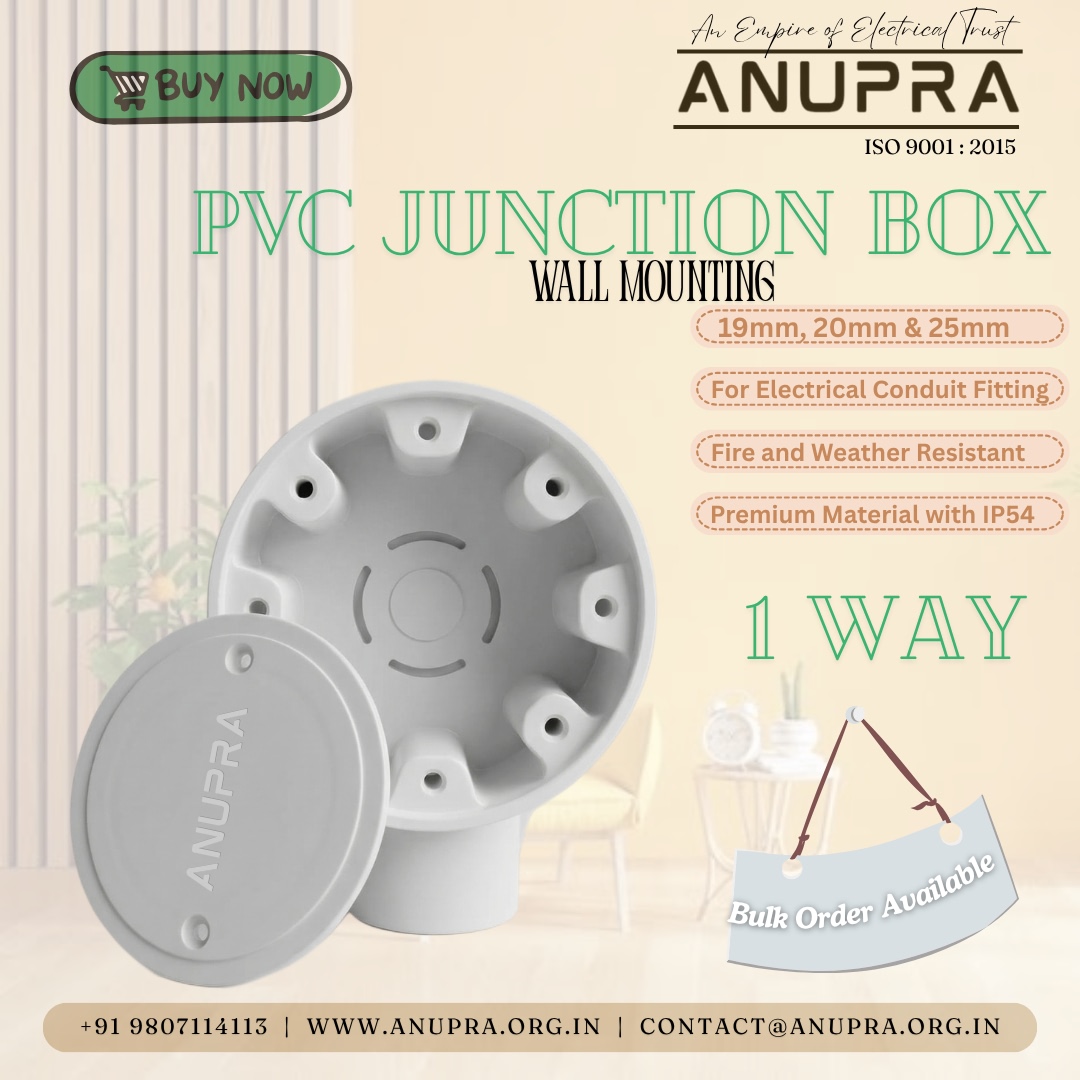
- Type 1 (1-Way Terminal Box): A single entry point. This acts as the final destination of a wire run, typically housing a wall-mounted light fixture, smoke detector or capping live wires safely.
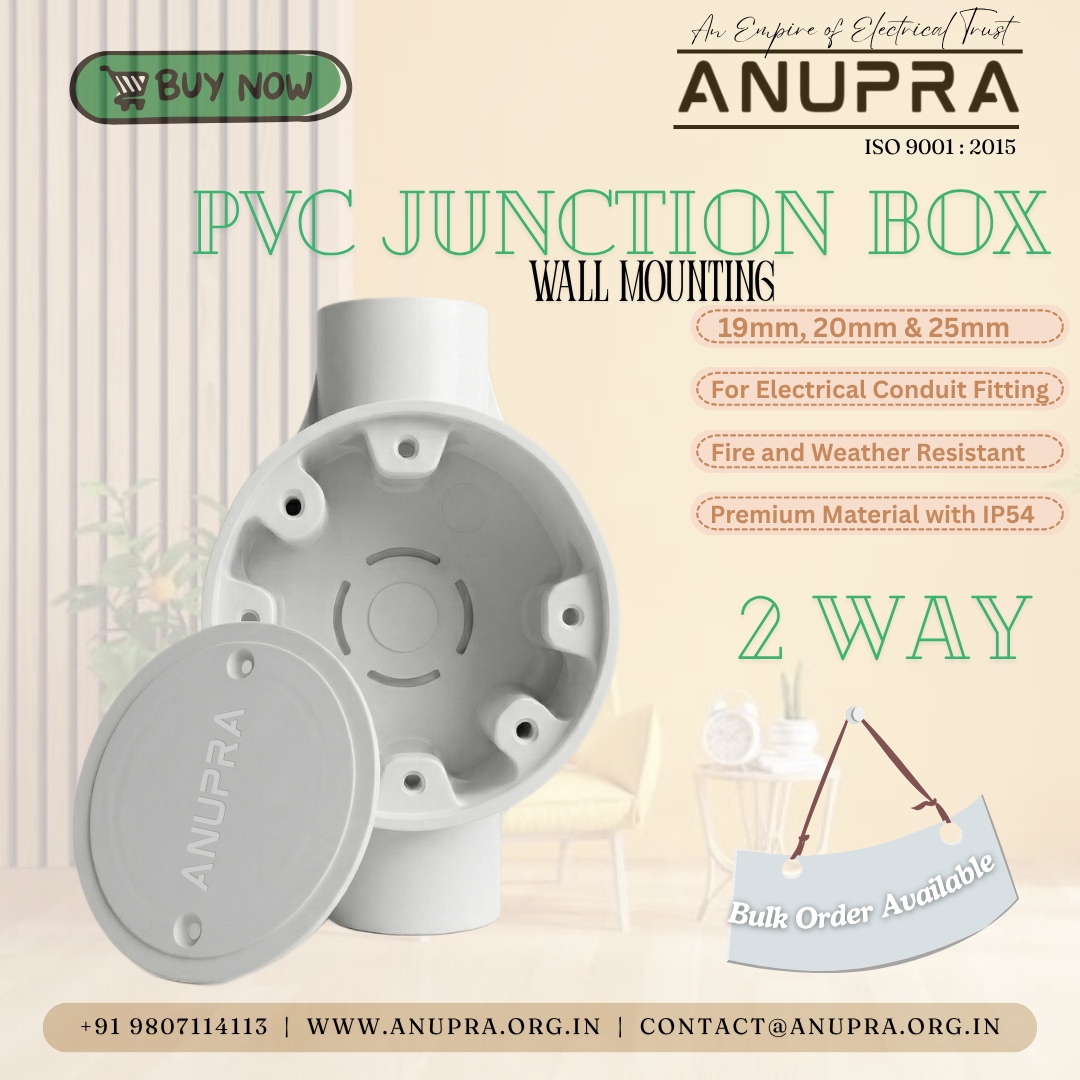
- Type 2 (2-Way Through or Angle Box): Two entry points. A "Through" box connects two straight pipes 180° apart. An "Angle" box is set at 90°, allowing wires to safely navigate corners without violating their minimum bend radius.
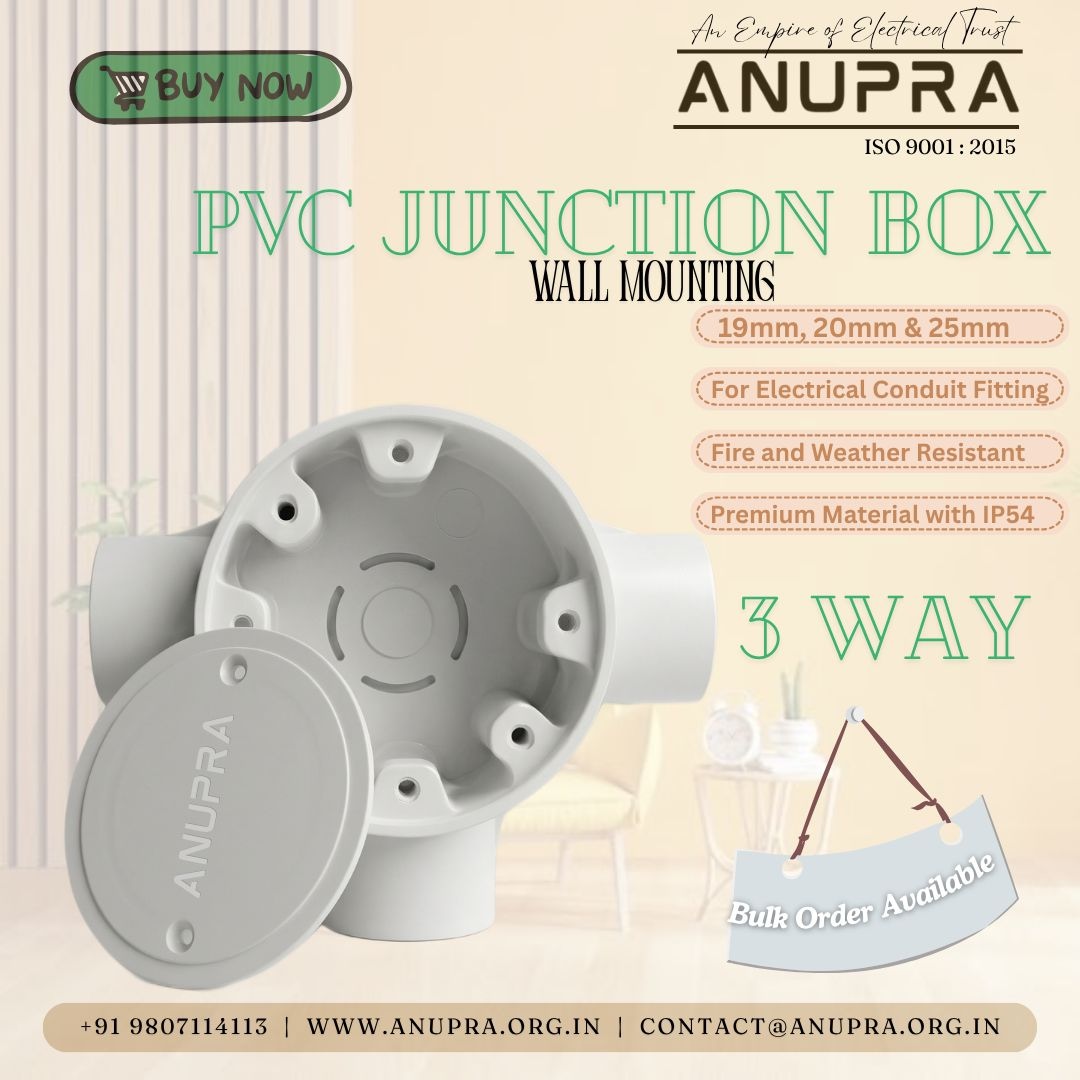
- Type 3 (3-Way Tee or Y-Type Box): Three entries. A PVC Junction Box 3 Way is the industry standard for dropping a branch line down to a wall switch while the main trunk line continues across the ceiling.
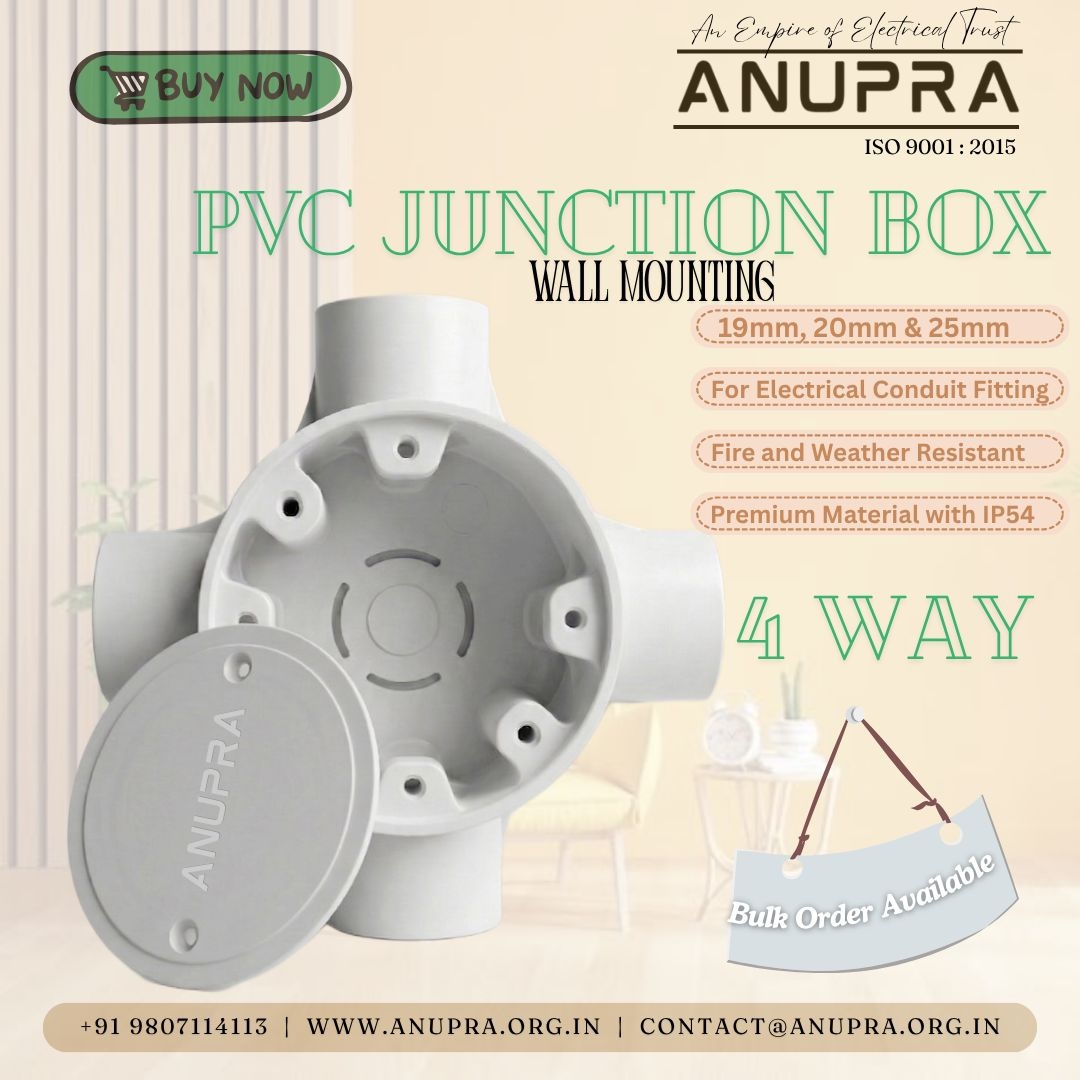
- Type 4 (4-Way Intersection Box): Four entries forming a cross. This is the ultimate hub, utilized when wiring converges from four distinct directions in a central grid.
5. Avoiding "The Volume Trap": Standard vs. Deep Junction Boxes
One of the most common junction box mistakes is overcrowding. Jamming too many wires, nuts & devices into a box tightly compresses conductor insulation, spikes electrical resistance, and creates a hazardous thermal buildup.
To solve this, manufacturers offer two distinct depth profiles:
| Box Profile | Internal Depth | Cubic Volume | Primary Application |
|---|---|---|---|
| Standard (Shallow) | 25mm to 35mm | ~14 to 18 cubic inches | 1-Way, 2-Way runs, basic 14 AWG lighting wire. |
| Deep (Extended) | 50mm to 65mm | 22.5+ cubic inches | 4-Way intersections, thick 10 AWG wire, housing smart-home relays. |
Note: While a Deep PVC Junction Box is an incredible problem solver, expect a 30% to 75% price premium over standard boxes due to the vastly increased uPVC material and extended cooling times during manufacturing.
6. Proper Installation: Hardware, Welding & Waterproofing
Properly installing a PVC junction box is not about twisting screws; it relies on chemistry and physics.
Chemical Welding
Unlike metal pipes that require threading, PVC conduit relies on chemical solvent welding. A solvent cement is applied to the pipe and the box hub. The solvent briefly melts the polymer chains. When they re-entangle seconds later, it creates a permanent, cold-welded joint that is entirely watertight and mechanically stronger than the pipe itself.
Structural Support and Expansion
Because PVC expands and contracts with temperature shifts, conduit runs must be structurally supported by saddles clamps every 600mm to 750mm. This allows the pipe to glide slightly, preventing stress fractures at the junction box nodes.
Waterproofing and Ingress Protection (IP Ratings)
- Is PVC 100% waterproof? Yes the material itself is, like standard indoor box and outdoor.
- Can a PVC junction box be buried? Only if it is explicitly rated for it. For outdoor, agricultural, or subterranean use, you must buy a box rated IP68 or NEMA 6P. These specialized boxes feature bolted perimeters, heavy-duty covers, and polyurethane foam-in-place gaskets to hermetically seal against extreme moisture.
7. Answering Top Electrical Rules and FAQs
To ensure this guide solves every problem you might encounter, let's address the most highly searched questions regarding electrical codes and safety.
What is the 125% rule in electrical?
To prevent chronic overheating, the National Electrical Code (NEC) states that for continuous loads (devices running 3 hours or more), the circuit and wiring must be sized to handle 125% of the total load.
What causes 90% of all fires?
In residential settings, the vast majority of electrical fires are caused by faulty, aged outlets, overloaded circuits, and specifically, localized problem from loose wire splices hidden outside of proper junction boxes.
What is the 6-foot rule for outlets?
NEC rules dictate that no point measured horizontally along a floor line in a residential space can be more than 6 feet from an outlet. This prevents the dangerous over-reliance on extension cords.
What are the 4 types of wiring?
Common wiring deployed through and around junction boxes include:
- Non-Metallic Sheathed Cable (Romex - residential).
- THHN/THWN Individual Conductors (pulled through PVC conduits).
- Underground Feeder (UF) Cable.
- Armored Cable (AC/BX - industrial metal sheathing).
Can I put a junction box in a wall?
Yes, but with a major caveat: the cover must remain accessible. It is a strict code violation to bury a junction box behind drywall, plaster, or tile without an access panel. Electricians must be able to reach it for future troubleshooting.
What are the 7 types of power problems?
If your electronics are failing despite good wiring, you may be experiencing power quality issues: Spikes, Interruptions (blackouts), Voltage Sags (brownouts), Voltage Swells, Waveform Distortion (harmonics), Voltage Fluctuations (flicker) & Frequency Variations.
8. Market Dynamics: Junction Box Prices and Top Brands
When researching Junction box low price options, it helps to know the market landscape. The global market is dominated by heavyweights like Precision Pipes, Finolex, Anupra, Polycab, GM, Schneider Electric (Clipsal), and ABB.
Base B2B pricing for a standard 20mm 1-Way PVC box often ranges from ₹16 to ₹25. As you move up to larger diameters (like 25mm), expect a linear 20% to 30% price increase. Features like overlapping lids, specialized FRLS materials, and deep-profile volumes will further increase the cost.
However, attempting to save a few rupees on a budget, non-certified box is a dangerous game. Always look for ISI-marked (like IS:3419 in India) or UL-listed products to guarantee the box can survive thermal and mechanical stress.
9. Conclusion: Securing Your Infrastructure
Whether you are configuring an Extension Junction Box for a home office or specifying heavy mechanical stress conduits for a factory floor, the junction box is the unsung guardian of your electrical grid. By understanding the volumetric limits (avoiding the volume trap!), adhering to proper chemical welding techniques, and selecting the correct material profile, you can ensure a safe, code-compliant installation that will last for over half a centuries.
Comments
Post a Comment